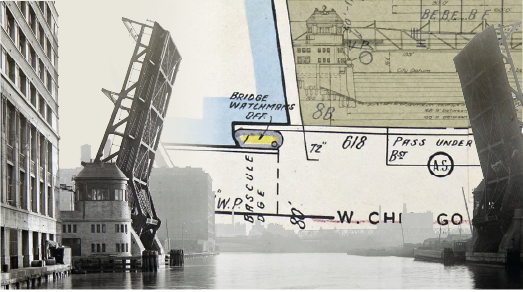
My thesis research centers around the demolition of the eastern bridge tender house of the Chicago Avenue Bridge. Completed in 1914, this bridge tender house was one of the first to be given an elevated architectural treatment following the implementation of the 1909 Plan of Chicago. Influenced by the City Beautiful Movement, the Chicago Avenue Bridge and its two operator houses began a new era of infrastructure design in Chicago. The bridge was removed in 2018 with both the eastern and western bridge tender houses demolished in 2026 as part of a plan to widen the river crossing and improve the north branch of the River Walk. Through documentation, material analysis, and multiple interpretive methods, strategies for preserving the memory of this important piece of Chicago infrastructure are proposed. Additional documentation of the eastern bridge house was completed through use of historic documents and photogrammetry to be added to existing records of the 1914 bridge. Analysis of material properties was conducted using concrete salvaged from the bridge abutment. Interpretive methods included proposed signage for the new River Walk, physical models, virtual recreations, and an exhibition.