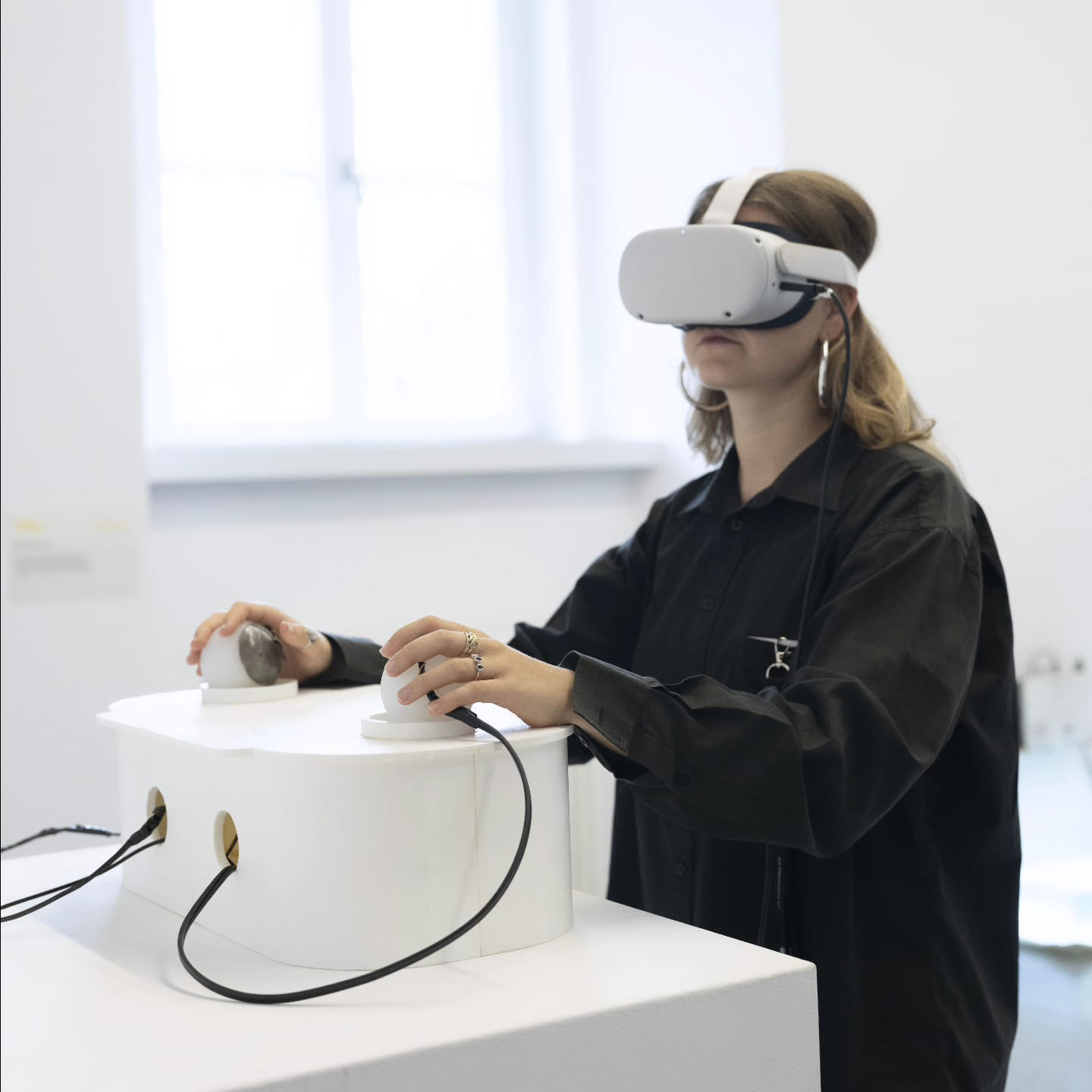
Ghosts of Reality, Video, VR-Set, 3D Printed Parts, Silicone, Pressure Sensors, Electronics components, Computer, 18 x 12 x 12 in.
Our cornea is a clear, dome-shaped window at the front of the eye that functions as a convex lens, focusing light through our eyes and onto the brain's visual cortex. In the condition known as keratoconus, the cornea progressively thins and bulges into a cone-like shape. This distortion of the cornea causes incoming light to scatter, leading to blurry, distorted, and often doubled or tripled vision. Daily activities such as reading, writing, and driving can become difficult. Although doctors prescribe hard contact lenses to accommodate a temporary cure of the condition, moderate and critical stages can’t be cured with this procedure which ultimately results in corneal transplant. In most cases people who are diagnosed with moderate stage of Keratoconus, starts with natural adaptation of the new vision. After I was diagnosed with moderate Keratoconus eight years ago, I found myself into a crisis of perception, a destabilizing shift in how I visually and emotionally experienced the world. It felt like I was losing not just my eyesight but my whole way of seeing the world. As an artist who has extensive works with illustration, sculpture and painting this was an extremely crucial and breaking point in life. However, over time this experience eventually transformed into a deeper understanding of vision and reality. Throughout several years; I’ve dealt and accepted this different visual reality and ultimately came to a realisation that this condition can act as a portal to a different way of perceiving the world. Keratoconus revealed a layered and fractured visual reality that people with normal sight or curable eyesight will never encounter. It showed me how reality itself can split, blur, and double. It leads to a new door of conversation that not only discuss about physical distortions in nature but also social, historical, and philosophical perspectives about duality, perception, and truth. This project explores that layered perception by creating an interactive visual and sonic experience that mimics the distortions caused by keratoconus. Two silicone eyes embedded with pressure sensors act as tactile controllers. When these are squeezed, they modulate the distortion of a projected video loop or a interactive environment, transitioning the visuals from overlapping, unfocused forms to a more focused visual. Through this sensory feedback mechanism viewers can physically engage with the idea of "seeking clarity" in a world of visual ambiguity. Moreover it’s not only about representing keratoconus in a scientific way. It’s about communicating what it feels like. The condition's causes are as layered as its symptoms. According to various medical studies contributing factors include genetic predisposition, environmental exposure (particularly to UV radiation), and behavioral influences such as eye rubbing—often a result of allergic reactions or habitual compulsion. Climate change is further exacerbating these risk factors through increased UV exposure and longer allergy seasons due to pollution and atmospheric instability. Further studies have also indicated environmental and climate changes in warm countries like in the Gulf and South or South East Asia has significantly increased the number of patients with keratoconus than the numbers in cold countries. These studies also invoke questions about the rules and regulations of environmental preservations of different countries and governments. My project metaphorically mirrors all these complexities. It combines lived experience, medical data, and embodied interaction to challenge singular notions of reality as well as invokes question about layered socio political movements and how it’s affecting the environment. Furthermore, as the visuals form the core concept of the project; audio plays a subtle yet powerful supporting role. I intend to create sound experience through stereo sound channels within a VR headset that consist layered voiceovers: clinical eye-test prompts mixed with poetic internal monologues. These frequencies are intended to become mono and centered when the silicone eyes are squeezed, simulating not just visual clarity, but psychological and perceptual alignment Ultimately, one part of this work is a reflection on the fragility of our perception and the possibility of empathy. It serves as a communicative bridge between those with normal or corrected vision and those with permanent, degenerative conditions. The other part of this work opens up a wider philosophical dialogue about how reality is interpreted and constructed through both biological and social lenses, about the feeling of trying to explain something no one else can see or understand. It’s also about telling stories of multiple layers of our society and nature that invokes the questions about global awareness, understanding and finding gray areas of multiple realities. It’s about touch, tension, and searching. It’s about the hope that even if you can’t see exactly what I see, maybe you can feel it.